


 Lamps
Lamps


 Sale
Sale
 Help
Help
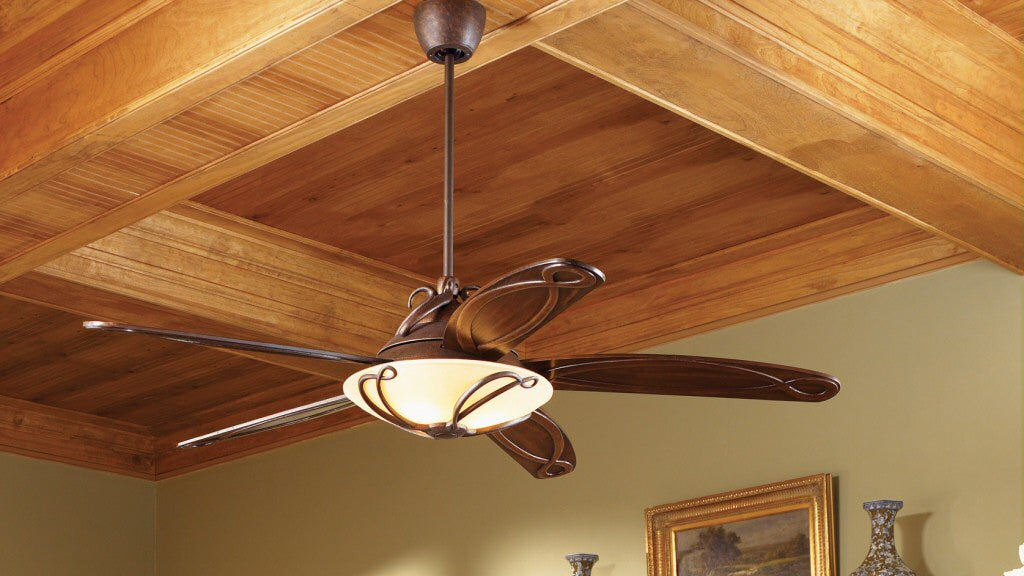
Ceiling Fan Buyer's Guide
Search
Choosing the right ceiling fan is more than just picking the right style and color. There are some key points that you want to keep in mind so that you make sure you get the right fan- so you not only cool your room correctly and efficiently, but you get years of use and enjoyment from your fan. Use our ceiling fan guide to help pick the perfect fan for your home.
-
STEP 1: Ceiling Fan Location
Most fans work best in the center of a room allowing air to flow smoothly and evenly through your space. With larger rooms, you may want to use 2 fans so that the room is cooled properly and you don’t over-tax a single fan. For safety reasons, remember to never mount a ceiling fan over a bed.>
-
STEP 2: Will the fan fit my room & my needs?
When installing a fan you need to check the height from the floor to the blades. Make sure you consider the distance the fan hangs down from the ceiling. For safety a height of 7’-9’ is recommended. If you fan does not meet the 7’ recommendation you should look into a low ceiling mount. For some areas there may be building codes that require this. -
STEP 3: Choose a quality ceiling fan
A cheap fan is going to be more trouble than it is worth. Not only do inexpensive fans wobble, but a poor quality fan will not circulate as much air at a given RPM. While speed helps control how much air is being moved, it is blade pitch (angle between the blade and a horizontal line) and design that play a key role. A good quality fan will have a motor that allows a fan to have a greater blade pitch. Cheap fans have motors that are not strong enough to handle the air resistance associated with a greater blade pitch, so those fans will have to lower the pitch to avoid the motor from burning out. Also cheap fans produce a humming nose. A good quality fan does not always mean it will be priced unreasonably high. Compare your CFM’s, motor size, and blade pitch and find a fan that has the best of all three factors and you will find yourself a winner.
What Ceiling Fan Size is Right?

It is important to choose the right size ceiling fan for your needs. This guide will help determine the correct size.
- 30” ceiling fans are for rooms up to 8’ x 10” (small bedrooms, most laundry rooms,smaller kitchens)
- 42” ceiling for rooms up to 12’ x 12’(medium bedrooms, most kitchens and small rec. rooms)
- 52” ceiling fans for rooms up to 18’ x 20’ (large bedrooms, most family rooms, most dining rooms)
Recommended Mounting by Ceiling Height
- Low Ceiling Heights: Use a hugger mount or mount without your downrod.
- Standard 8’ Ceilings: Use a traditional mount without downrod.
- 9’ or Higher Ceilings: Use an extended downrod
Sloped Ceiling: Use the appropriate slope ceiling adapter and extended down rod.
Consider These Tips When Choosing a New Ceiling Fan
- Ceiling Fan Rotation (more) - Ceiling fans should rotate counter clock- wise in the summer (to generate a breeze downward to cool you off) and clock-wise in the winter (to cycle the warm air that rises to your ceiling.) Do not be afraid to run your ceiling fan in the winter. You can expect a 10-15% savings on your heating bill. You can save up to 40% off your cooling bill in the summer by properly setting your ceiling fan rotation. (although you should only run the fan when you are in the room to enjoy its cooling effect).
- The Buzz - Don't buy a multi-speed fan with only one capacitor inside its motor. A quality fan able to handle three speeds should have at least three capacitors.
- Blade Pitch - For a ceiling fan to move the right amount of air, its blades should be set at a 14 degree angle. Blades set at a 10 degree angle will simply slice the air, while blades at a 20-degree angle will meet so much resistance that the motor may burn out.
- Avoid "Huggers" - Don't fit the ceiling fan too snugly to the ceiling; doing so will prevent it from circulating air properly. (except with smaller ceilings 8' or lower).
- Keep a Safe Distance - Set fan clearance at 9 feet above the floor if possible (if this is not possible, maintain a minimum clearance of 7 feet. This will help you and your family avoid injuries.
- Proper Installation - Because it's much more complicated to install a ceiling fan than a ceiling light fixture, you might want to consider having your ceiling fan put in by a licensed electrician. Ceiling fans need additional support from above and need to be anchored solidly to a stud. (fan rotation can work metal screws loose.)
- Lower your utility bill - Outfitted with a good ceiling fan, you can raise your thermostat setting and save substantially on air-conditioning costs. By reversing the direction the ceiling fan blows the air you will save in the winter as well. You can expect a 10-15% savings on your heating bill. You can save up to 40% off your cooling bill in the summer.
Ceiling Fan Blade Cleaning Tip from the PROS!
Ceiling fans are a great way to stay cool in the summer and re-circulate hot air in the winter. But those fan blades can sure collect dust over time! Cleaning them can be a pain.
Here are two clever tricks to help you keep your ceiling fan blades clean and running great
Cleaning Tips It’s In The Bag!
Take an old pillow case and get it a little bit damp. Put the case over each blade one at a time (like a pillow). Then gently pull it off and you pull the dust and dirt off without having it go everywhere and it all stays in the pillowcase.
For the really dirty fans that need some extra attention take an old pair of cotton socks and dip them in some soapy water made with dish detergent. Ring them out so they are just damp. (remember we are working with an electrical fixture) Put them over your hands and then run your hands over the top and bottom of each blade. The dust will stick to the wet socks and it takes just minutes.
Shop Ceiling Fans
Explore Topics



Comments